
Fairfax County Death Index
Fairfax County death records are held by the Circuit Court Clerk in Fairfax and by the Virginia Department of Health in Richmond. As the most populous county in Virginia, Fairfax County has a large volume of death records and extensive online access through its court system. Researchers should note that Fairfax County borders two independent cities, Falls Church and Fairfax City, which maintain their own separate records. Deaths occurring within those city limits are filed under city records, not county records.
Fairfax County Overview
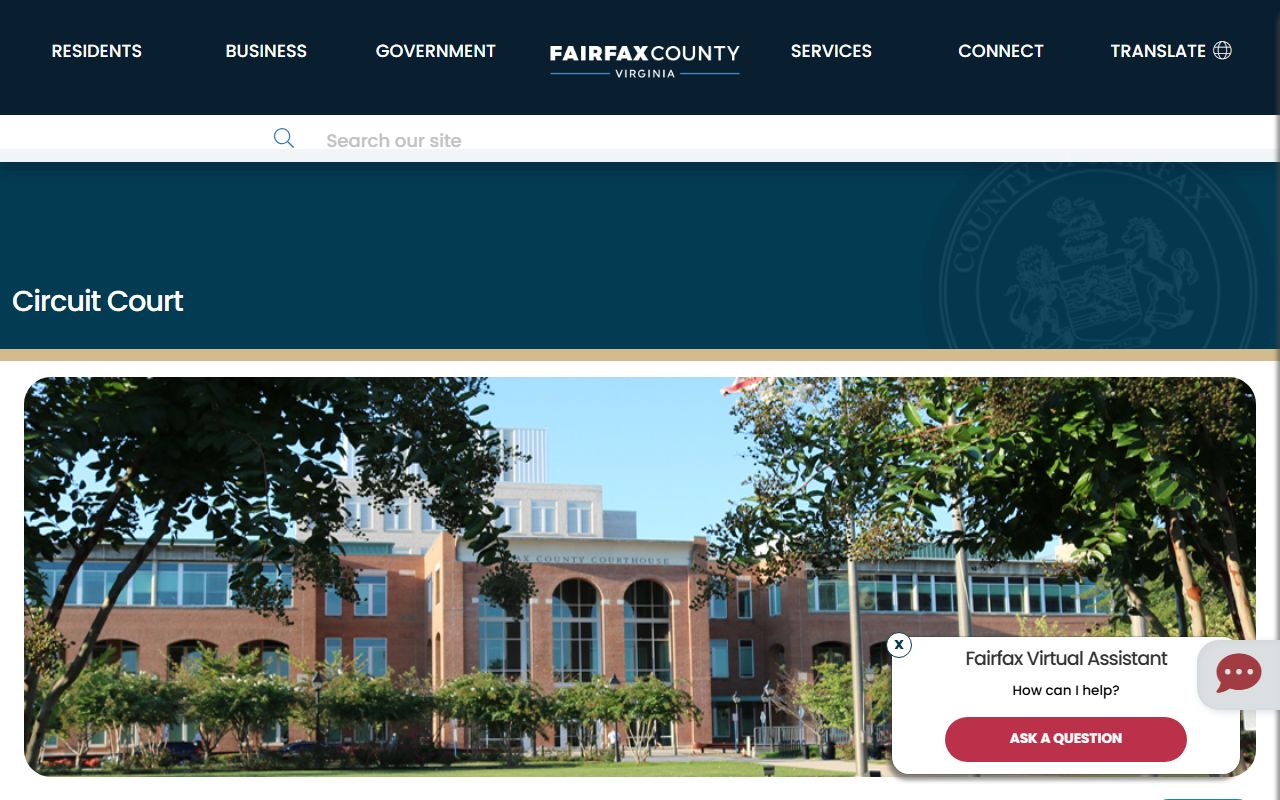
Fairfax County Circuit Court Clerk
The Fairfax County Circuit Court Clerk's Office handles probate matters, wills, land records, marriage licenses, and court case files for the county. The Fairfax County Circuit Court has extensive online records and is one of the more accessible county court systems in Virginia. The clerk does not issue certified death certificates. Those must come from the Virginia Department of Health in Richmond or from the Fairfax County Health Department for certain local vital records services.
Fairfax County's Circuit Court website offers online access to many court records, including probate filings. When a county resident dies with property, the family typically files probate documents at the court. Those filings can include the date of death, names of heirs, and details about the estate. Will books and estate inventories going back to 1742 are held at this office. For deaths after the 25-year privacy cutoff, probate records can help confirm a date of death when the certificate itself is restricted.
Fairfax County also has a local health department that can provide guidance on vital records requests. The Fairfax County Health Department does not issue certified death certificates, but staff can direct researchers to the right state office or local resources. For court case searches, the Virginia Online Case Information System covers Fairfax County civil, criminal, and probate cases at no cost.
Virginia Death Records for Fairfax County
The Virginia Department of Health, Office of Vital Records holds certified death certificates for Fairfax County deaths from June 1912 to the present. The office is at 8701 Park Central Drive, Suite 100, Richmond, VA 23227. Walk-in hours run Monday through Friday, 7:00 a.m. to 4:00 p.m. Mail requests go to P.O. Box 1000, Richmond, VA 23218-1000. Phone is (804) 662-6200.
Each certified copy costs $12. Under Virginia Code Title 32.1, Chapter 7, death records become public 25 years after the date of death. Before that window, only immediate family may request a copy. Eligible relatives are the spouse, parent, child, sibling, or grandparent of the deceased. A government-issued photo ID is required with every request. Given the county's large population, VDH processes a high volume of Fairfax County certificate requests.
For online orders, VitalChek is the state's authorized third-party service. An extra processing fee applies on top of the $12 state fee. VitalChek handles deaths from June 1, 1912 forward. Certified copies can also be obtained at full-service Virginia DMV locations for a $2 processing fee added to the state cost.
Search the Fairfax County Death Index Online
The Virginia Online Case Information System (OCIS) allows free searching of Fairfax County court records. Search by name or case number for probate, civil, and criminal matters. Fairfax County generates a large number of probate filings each year, making this a practical resource for locating estate records connected to recent deaths.
The Library of Virginia holds Fairfax County death register microfilm from 1853 to 1896. These registers include the name, date and place of death, cause of death, age, sex, race, occupation, and parent names of the deceased. The microfilm is available for interlibrary loan. Fairfax County was a largely rural area in the nineteenth century, so these older records can be very useful for tracing families before the county's modern growth.
Virginia residents can use Ancestry for Virginians at no charge. This includes Virginia Death Records from 1912 to 2014 and Virginia Death Registers from 1853 to 1911. A Library of Virginia card or a card from a participating public library is required. Fairfax County Public Library participates in this program, so residents can log in using their library card.
FamilySearch provides free Virginia death databases including Virginia Deaths and Burials from 1853 to 1912. Index data and images from original register pages are available. FamilySearch is a useful free starting point for historical Fairfax County death research.
Fairfax County Death Records: Historical Research
Fairfax County was formed in 1742 from Prince William County. The county sits in Northern Virginia, adjacent to Washington, D.C. Death records follow the standard Virginia timeline: registers from 1853 to 1896, a gap from 1897 through May 1912, and modern certificates from June 1912 forward. Before 1853, church records, estate filings, and family papers are the best sources. Fairfax County was a major plantation county in the eighteenth and nineteenth centuries, and the Circuit Court holds estate records from that era that can serve as indirect death documentation.
The county's growth after World War II made it the most populous county in Virginia by the 1980s. This means a very high volume of death records exists for the modern period. The Virginia Genealogical Society sponsors the Death Index of Virginia, 1853-1896, which covers Fairfax County records from the death register era.
Deaths from 2000 and earlier are now past the 25-year mark and are public records. Deaths from 2001 onward remain restricted to immediate family. Federal mortality census schedules from 1850 to 1880 are held at the Library of Virginia on microfilm and cover Fairfax County residents who died in those census years. The Library of Virginia holds a statewide death index through 1954, giving certificate numbers for ordering copies from VDH.
Nearby Counties
These counties border or sit near Fairfax County. Each has its own Circuit Court and vital records resources for deaths in those jurisdictions.