
Virginia Death Index
The Virginia Death Index is the statewide record of deaths filed with the Virginia Department of Health, covering events from 1853 to the present. You can use this index to find a death certificate, confirm a date of death, or trace a family line across multiple generations. Records are held at the Office of Vital Records in Richmond and at the Library of Virginia. Searching the Virginia death index can point you to certified copies, historical death registers, and several free online genealogy databases. This page explains where to search, who can access records, how to order a copy, and what the records contain.
Virginia Death Index at a Glance
Where to Find the Virginia Death Index
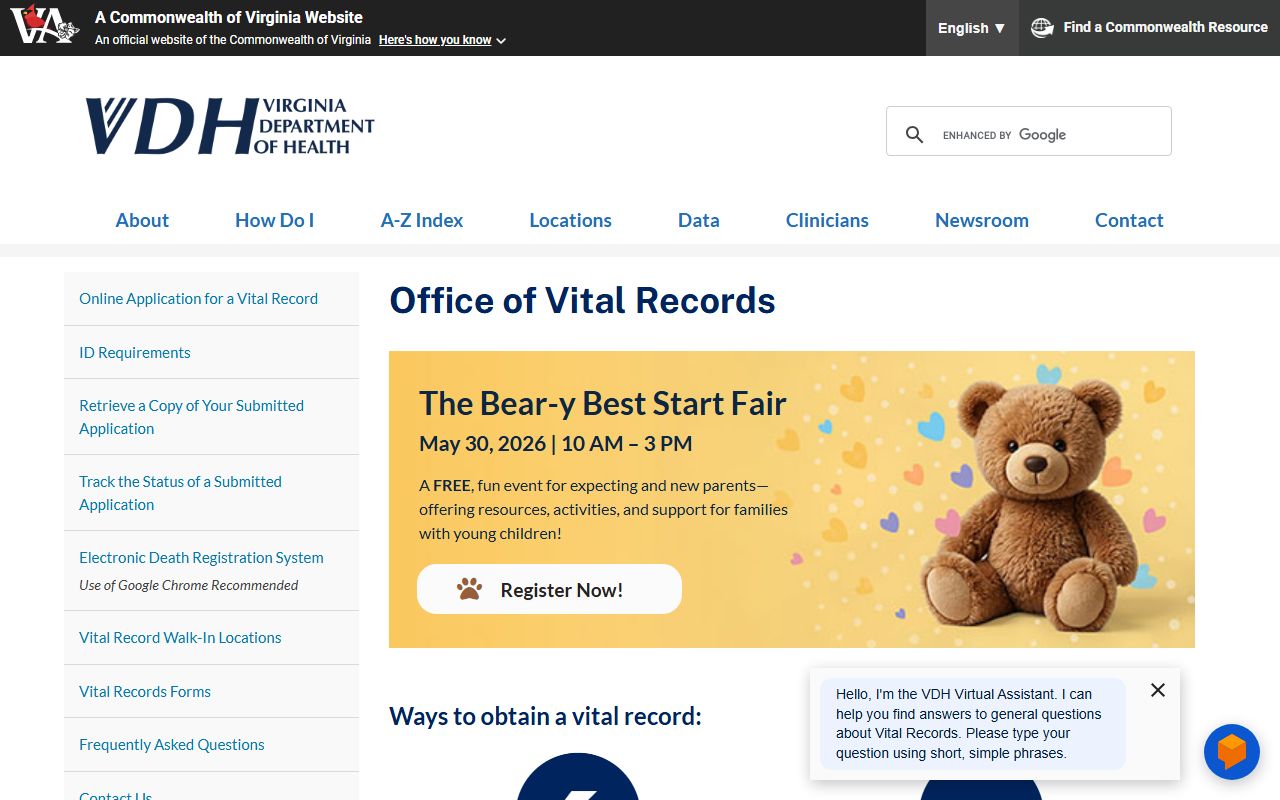
The main source for Virginia death records is the Virginia Department of Health, Office of Vital Records. This office holds certified death certificates for all deaths that occurred in Virginia from June 1912 to the present. The customer service lobby sits at 8701 Park Central Drive, Suite 100, Richmond, VA 23227. Walk-in hours run Monday through Friday, 7:00 a.m. to 4:00 p.m. You can also mail a request to P.O. Box 1000, Richmond, VA 23218-1000, or apply through the VDH online system. Local health departments in each county and city can also issue copies for recent deaths in their jurisdiction.
Death records are not public until 25 years after the date of death. Only immediate family can get a copy before that point. Eligible family includes the spouse, parent, child, sibling, or grandparent of the person who died. You must present a valid government-issued photo ID with any request. Aunts, uncles, cousins, and in-laws are not eligible under Virginia law. Once a record is 25 years old, it becomes public and anyone may request a copy. The main office phone is 804-662-6200, open Monday through Friday from 8:00 a.m. to 4:30 p.m.
Virginia Death Records Before 1912
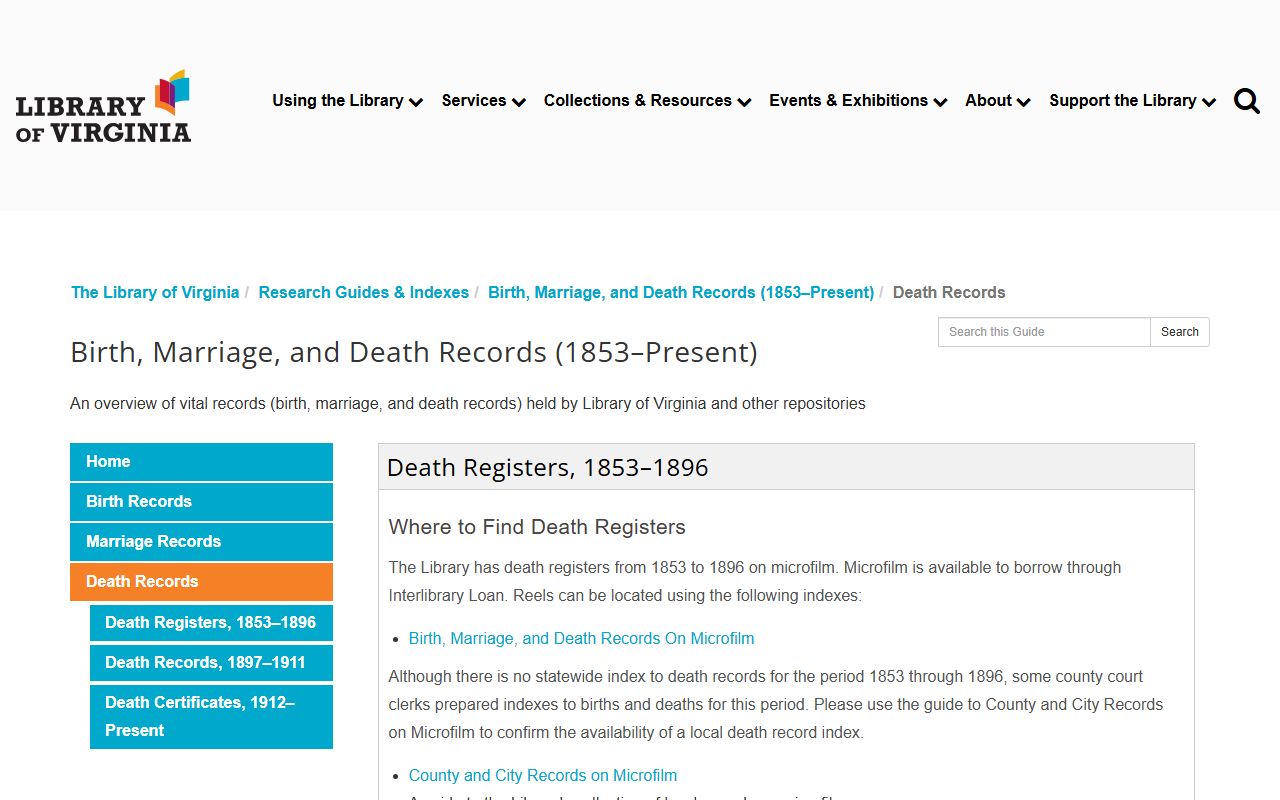
Virginia has two separate eras of death registration. The first covers 1853 to 1896. A General Assembly law required each county Commissioner of Revenue to record births and deaths annually. The clerk of court in each locality entered that data into registers and created an alphabetical index. This continued until 1896, when the legislature repealed the recording law. From 1897 through June 14, 1912, most counties kept no death records at all. A few metropolitan areas continued on their own, including the cities of Lynchburg, Newport News, Norfolk, Petersburg, Portsmouth, Richmond, Roanoke, and Elizabeth City County.
The Library of Virginia holds death register microfilm from 1853 to 1896. You can borrow reels through interlibrary loan. The Library also keeps microfilm copies of death certificates from 1912 to 1939, arranged chronologically by year and month. Prior to 1932, city records were filed with the county where the city sat. From 1932 on, cities and counties were filed separately. The Library holds a death index through 1954. An index entry gives you the year of death and the certificate number, which you use to request the full record. The Library is at 800 East Broad Street, Richmond, VA 23219. Archives reference is 804-692-3888.
Each death register entry from 1853 to 1896 includes the name of the deceased, race, sex, date and place of death, cause of death, age at death in years and months, place of birth, occupation, marital status, names of parents, and the name and role of the person who gave the information. Some entries also record the name of an enslaver for enslaved persons. The Virginia Genealogical Society sponsored the Death Index of Virginia, 1853-1896, which is searchable through the Library of Virginia.
How to Search the Virginia Death Index Online
Several tools let you search the Virginia death index from home. The best option for Virginia residents is Ancestry for Virginians. This program gives free access to Virginia-specific Ancestry records through the Library of Virginia. You need a Virginia public library card or a free Library of Virginia card. Once logged in, you can search the Virginia Death Records index from 1912 to 2014 and the Virginia Death Registers from 1853 to 1911. Records less than 25 years old show indexed data only, not images. The Ancestry for Virginians program page has instructions on how to get started.
FamilySearch offers free Virginia death databases including Virginia Deaths and Burials 1853-1912, Virginia Death Certificates 1912-1987, and the Social Security Death Index 1935-2017. Some collections are open to any user; others can only be viewed at a Family History Center. FamilySearch is free after creating an account. It covers many of the same records as Ancestry but with different indexing, so both are worth checking if results are thin in one place.
The Virginia Online Case Information System (OCIS) covers circuit court cases statewide. When someone dies and their estate goes through probate, that becomes a court case. You can search OCIS by party name or case number at no cost. Probate records often include wills, asset lists, and estate inventories. These can be useful when the death certificate alone does not give the detail you need.
Ordering a Virginia Death Certificate
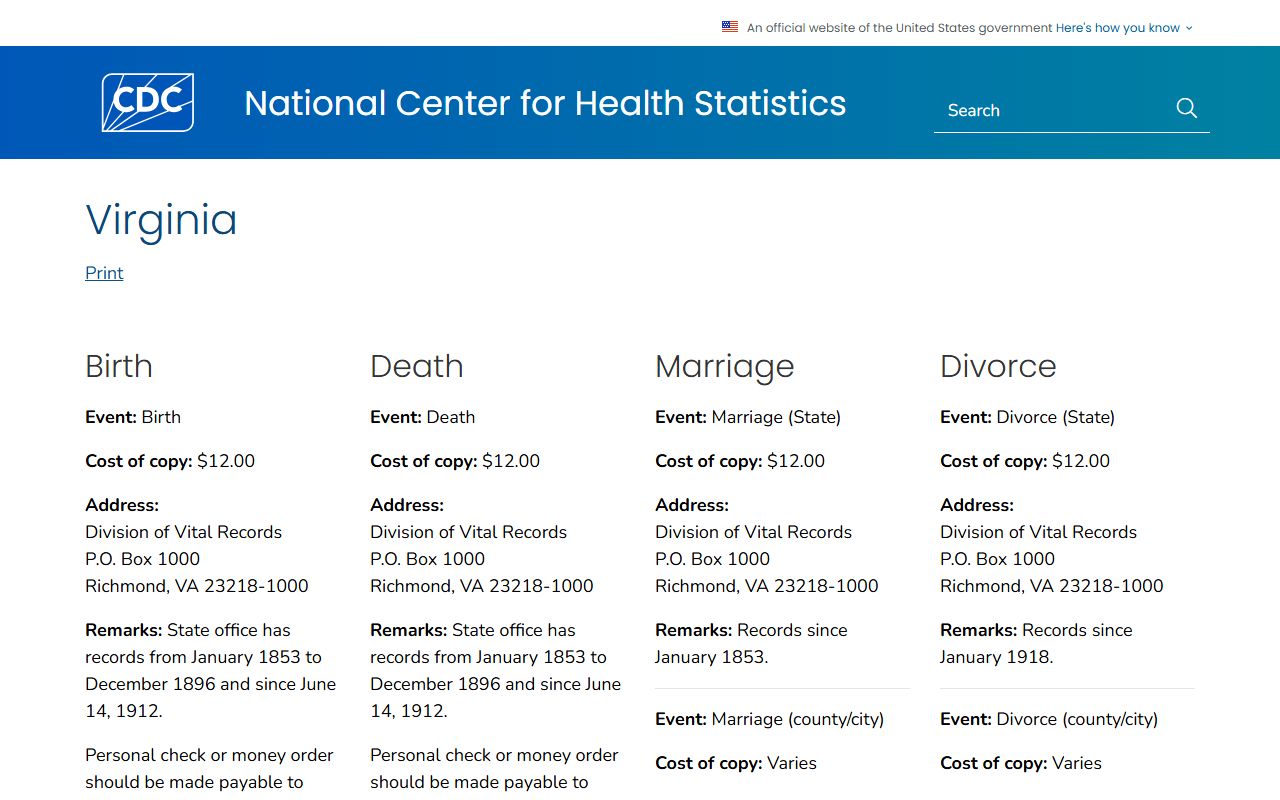
You can order a certified copy by phone, online, in person, or by mail. The fee is $12 per copy. For online orders, VitalChek is the authorized third-party service that works with the Virginia Department of Health. VitalChek charges an extra processing fee on top of the $12 state cost. Orders cover deaths from June 1, 1912 to the present. You can pay by credit or debit card. VitalChek's customer service is at 877-572-6333.
Walk-in service at the Richmond office generally handles requests the same day. Bring a legible photocopy of your government-issued ID. Acceptable IDs include a driver's license, state ID, passport, or military ID. Payment options in person are check, money order, credit card, mobile pay, or cash. Checks and money orders go to State Health Department. For drop-off requests, pick-up must happen by 2:00 p.m. and only the person named on the request may collect it.
Mail requests go to VDH, Office of Vital Records, P.O. Box 1000, Richmond, VA 23218-1000. Include a copy of your ID and payment. Standard mail processing takes about two weeks. Virginia DMV full-service locations also issue certified death certificates at the $12 rate plus a $2 processing fee. The CDC reference page for Virginia vital records confirms the $12 fee and lists the VDH mailing address as the authoritative contact for out-of-state requesters.

Virginia Death Index Laws and Access Rules
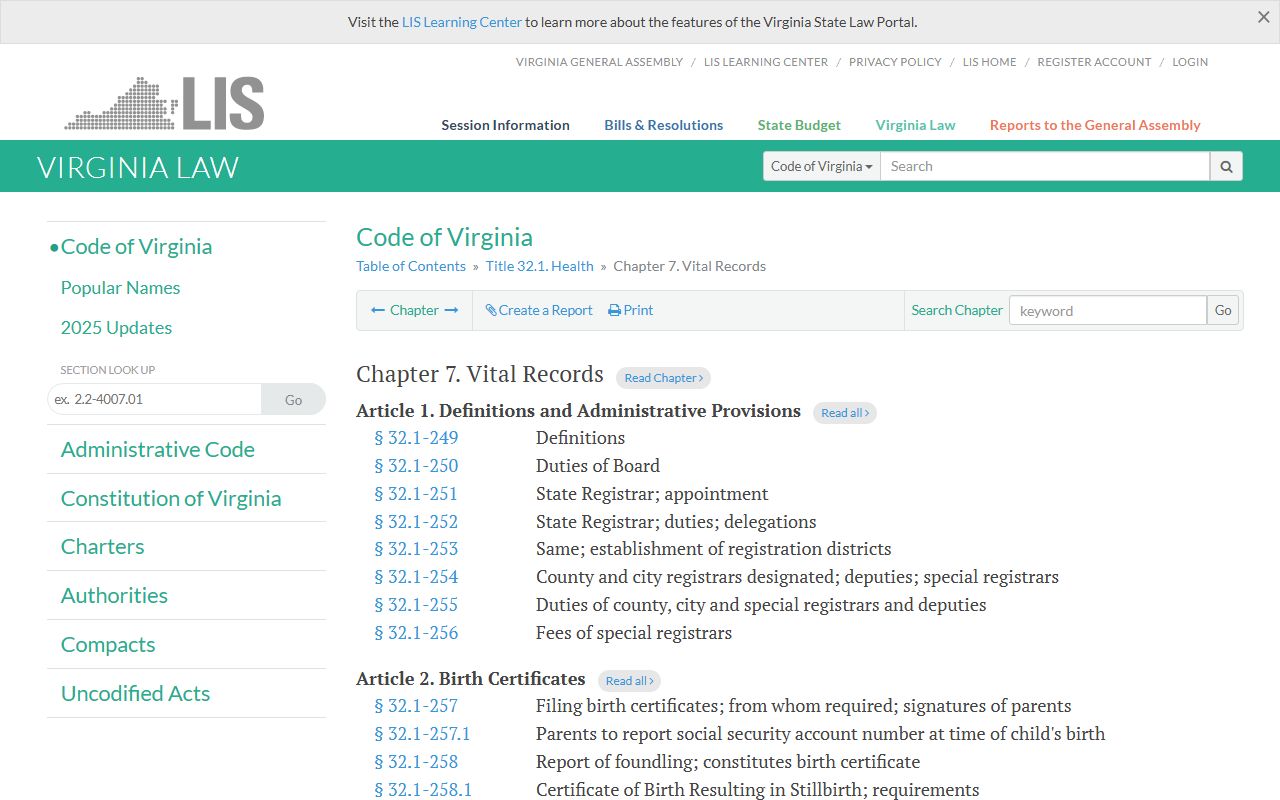
The legal framework for death records in Virginia comes from Virginia Code Title 32.1, Chapter 7, which governs the entire vital records system. Section 32.1-249 defines vital records. Section 32.1-252 sets out the State Registrar's duties. Section 32.1-254 assigns each county and city health director as the local registrar. Under Section 32.1-263, a death certificate must be filed within three days of death and before the body is moved out of state. The filing obligation falls on the funeral director in most cases.
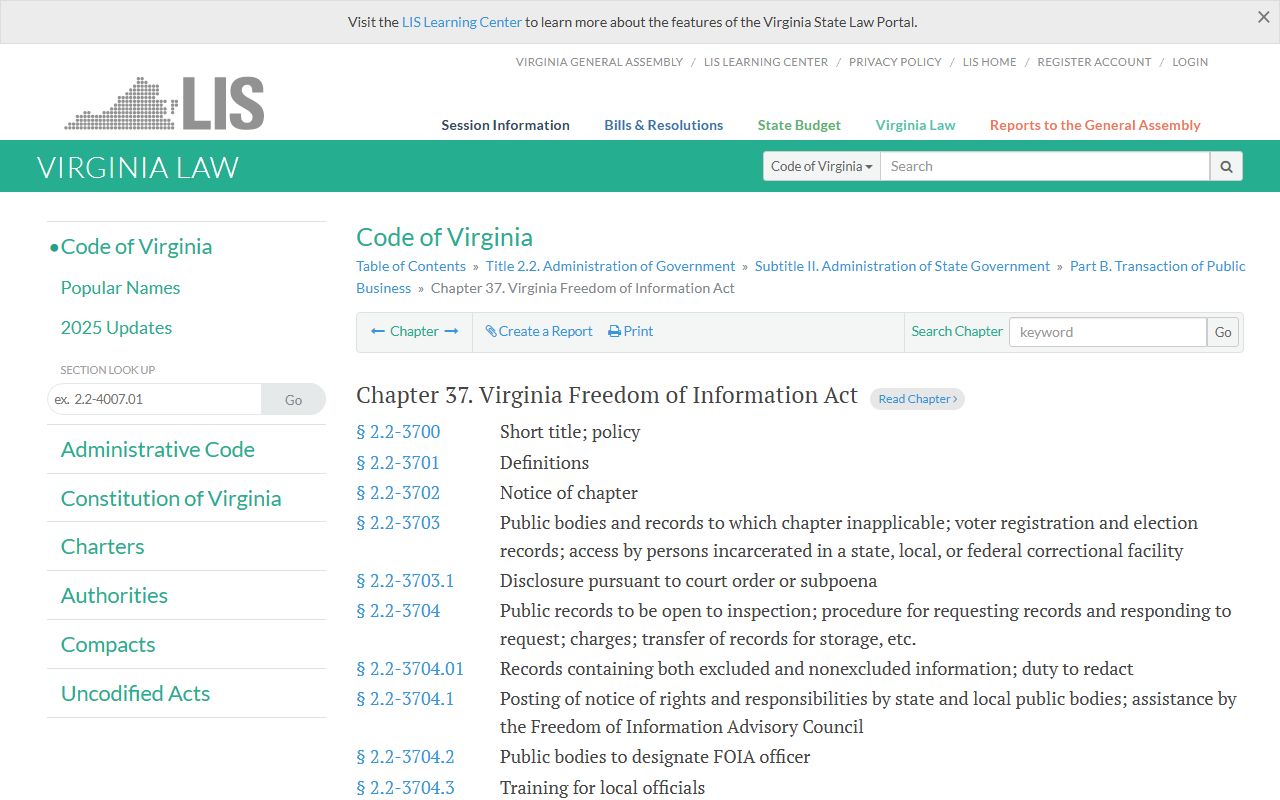
Under Section 32.1-271, death records become public information 25 years after the date of death. At that point they transfer to the Library of Virginia for long-term storage and are open to anyone. Section 32.1-273 caps the fee at $12 per certified copy. Section 32.1-276 makes it a Class 4 felony to file false statements in vital records or to obtain records through fraud. Death certificates are not public body records under the Virginia Freedom of Information Act, Title 2.2, Chapter 37. Requests must go through the Virginia Department of Health, not through a city or county FOIA office.
The Virginia Medical Examiner System
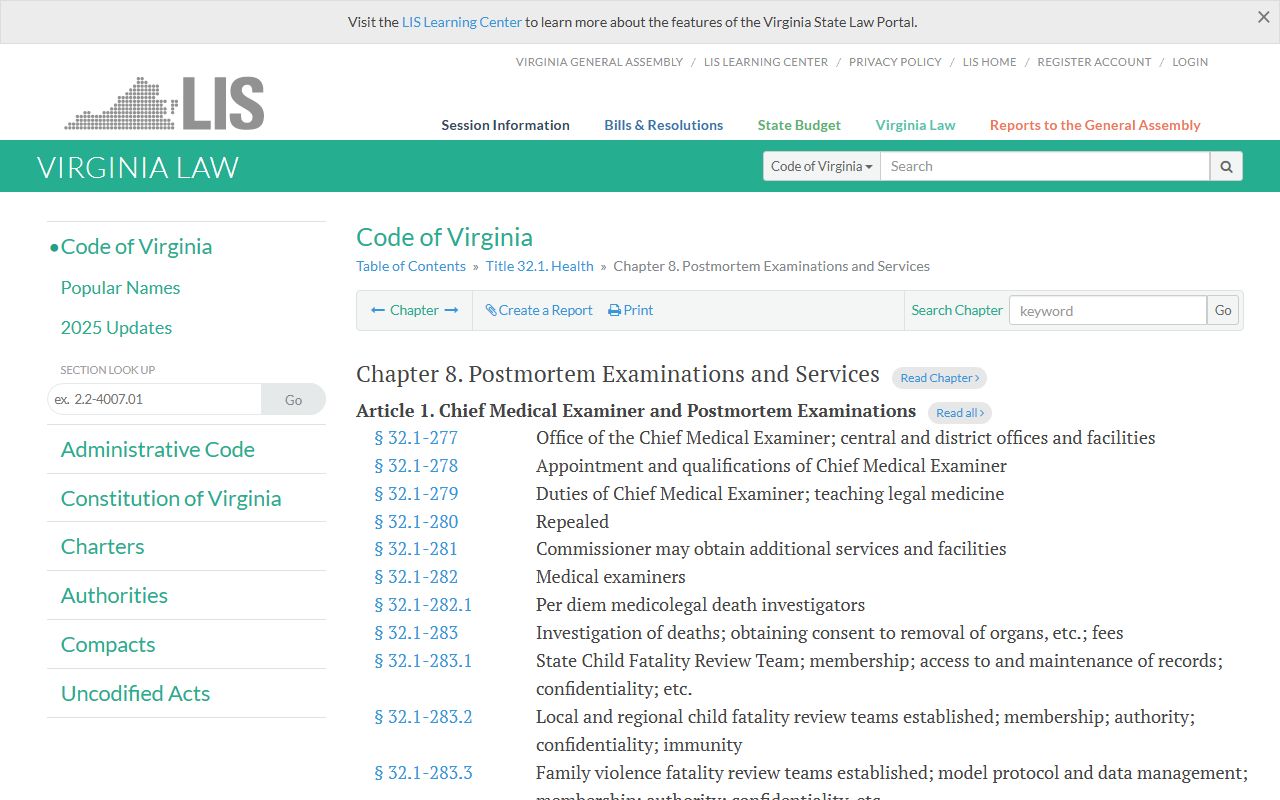
Not every death in Virginia follows the standard death certificate path. Virginia Code Title 32.1, Chapter 8 creates the Office of the Chief Medical Examiner and sets out when that office must be notified. Under Section 32.1-283, the OCME gets involved in deaths from trauma, injury, violence, poisoning, accident, suicide, or homicide; sudden deaths when the person appeared well beforehand; deaths not attended by a physician; deaths in jail, prison, or police custody; deaths that seem suspicious, unusual, or unnatural; and sudden deaths of any infant.
OCME reports and findings are confidential under state law and are not subject to court subpoena except as Chapter 8 allows. If you need death information from a case the Medical Examiner handled, you may need to contact the OCME directly or seek the record through a formal legal process. The office has locations in Richmond, Norfolk, and Roanoke to serve different regions of the state.
Genealogy Resources for Virginia Death Index Research
The Virginia Genealogical Society is a nonprofit that has played a direct role in making Virginia death records searchable. The society sponsored the indexing of the Death Index of Virginia, 1853-1896, which is available through the Library of Virginia. VGS publishes a quarterly research newsletter, hosts annual conferences, and maintains a library of Virginia genealogy publications. If you are tracing a Virginia family line, membership in VGS can give you access to research tools and expert guidance that go beyond the public databases.
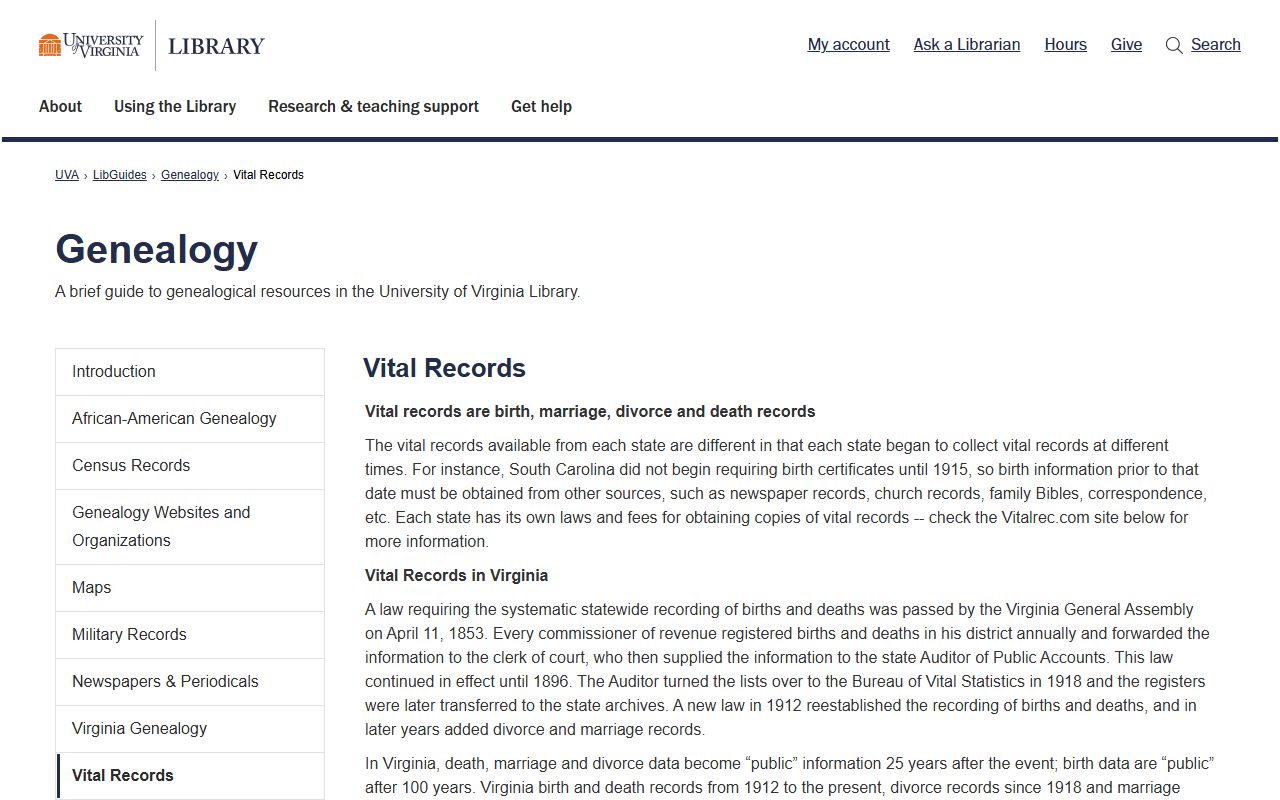
The University of Virginia Library research guide for vital records explains record availability by time period and provides direct paths to the major collections. The Library does not hold vital records itself, but the guide is one of the clearest overviews of what exists and where. The UVA library's Government Information Reading Room also holds federal mortality census schedules on microfilm for 1850, 1860, 1870, and 1880. These schedules list name, age, sex, place of birth, occupation, month of death, and cause of death for people who died in the census year. They can fill in gaps when other records are missing.
The Virginia Memory digital platform, run by the Library of Virginia, offers access to chancery court records, Confederate pension applications with death information, cemetery surveys from the WPA period, and veterans' gravesites databases. These collections often contain death details not found in standard vital records and can be especially useful for families from the 19th century.

Virginia Electronic Death Registration
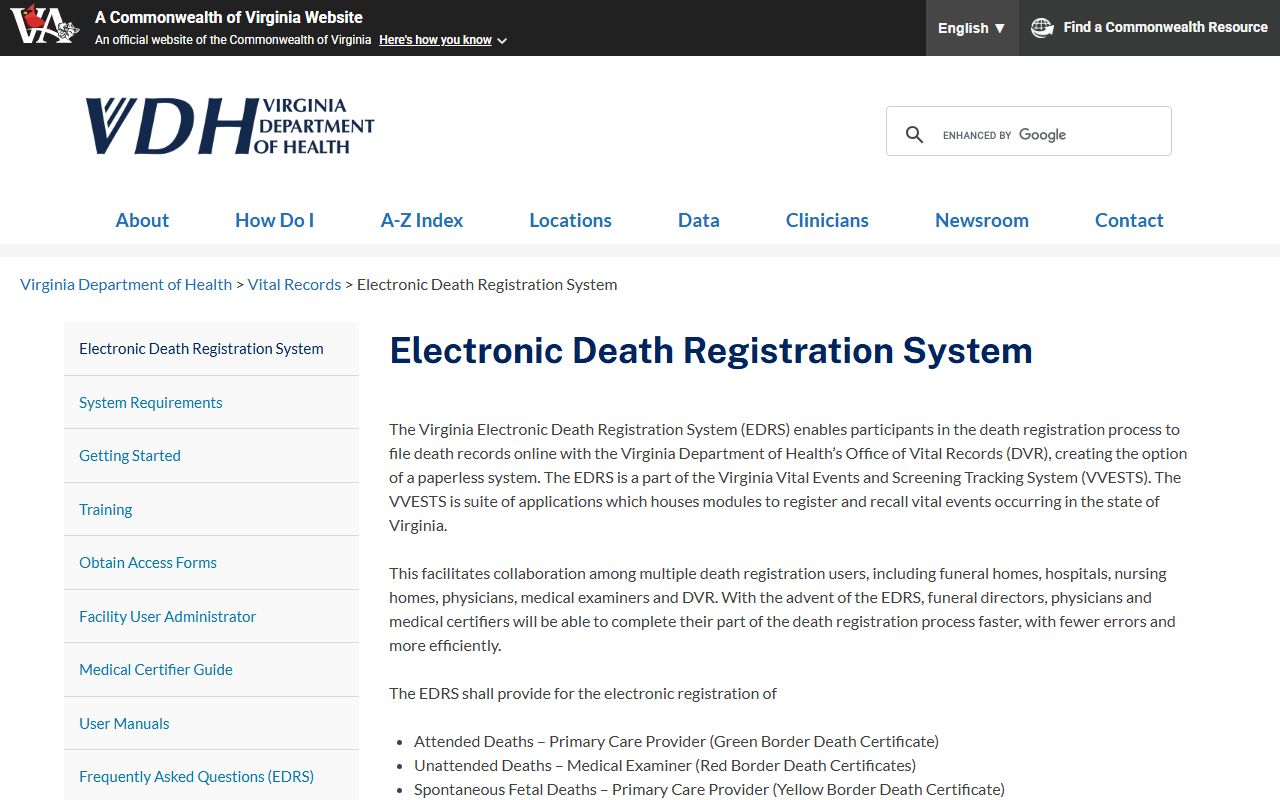
Modern Virginia death certificates go through the Electronic Death Registration System (EDRS). Funeral directors and physicians use EDRS to file certificates electronically. The system requires filing within three days of death under Virginia Code Section 32.1-263. Medical certifiers complete their portion within 24 hours. EDRS links directly to the state vital records database, so records enter the system faster than under the old paper process. For requesters, this means recent records are generally available sooner.
Browse the Virginia Death Index by County
Virginia has 95 counties, each with its own circuit court and local health department. Select a county below to find specific resources for Virginia death index records in that area, including circuit court contact details and local vital records access.
Virginia Death Index in Major Cities
Virginia has 39 independent cities, each operating its own circuit court and health department. Select a city to find death record resources and the Virginia death index for that area.